Let’s be honest with each other. A lot of us grew up seeing the big belly as a sign of a man who’s doing alright. Unc at the cookout, plate full, laughing loud. We call it a “dad bod,” a “grown-man stomach,” “good living.”
And let’s keep it real: we know how to dress it up and make it look good. We’ll have the latest fashions, and we look great in our clothes. But once we take them clothes off and that belly falls over that belt buckle, the truth comes out.
And that truth matters, because that belly can be one of the most dangerous things you carry. Not because of how it looks. Because of what’s sitting underneath it.
This isn’t about a six-pack. It’s about staying around, staying able, and staying in the game: walking 18 holes, getting up off the floor with your grandkids, and knowing your numbers are where they need to be.
Two kinds of belly fat
Not all fat is the same. There are two main types around your midsection:
- Subcutaneous fat sits right under the skin. It’s the fat you can pinch.
- Visceral fat sits deep inside your abdomen, wrapped around your liver, pancreas, intestines, and even your heart (Harvard T.H. Chan School of Public Health).
That deep fat is the problem. A firm, hard belly that “sticks out” is often a sign of visceral fat pushing your abdominal wall outward from the inside.
Why visceral fat is dangerous
Visceral fat isn’t just storage. It’s active tissue that behaves almost like an organ, and not a friendly one.
- It’s linked to insulin resistance and other metabolic problems, and it releases inflammatory substances that damage arteries and set the stage for heart disease (Harvard Health Publishing).
- Too much of it is tied to higher risk of cardiovascular disease, type 2 diabetes, and certain cancers (Harvard T.H. Chan School of Public Health).
- At every waist size, men tend to carry more visceral fat than women, which raises men’s risk of glucose problems and type 2 diabetes (National Institutes of Health, PMC).
The scale can fool you. Waist size and waist-to-hip ratio are better signals of metabolic health than BMI, and men with a waist of 40 inches or more are at significantly higher risk, even at the same BMI as other men (Harvard Health Publishing).
Why we have to pay attention
Here’s where it gets personal. The very conditions visceral fat feeds are the ones hitting our community hardest.
- About 56.8% of Black men age 20 and older have hypertension (CDC FastStats).
- Black adults were 24% more likely than U.S. adults overall to have diabetes in 2024, and Black men died from diabetes at a rate of 52.8 per 100,000 compared with 30.5 for all U.S. men in 2022 (HHS Office of Minority Health).
- Black Americans were 35% more likely than the overall U.S. population to die from major heart and blood vessel diseases in 2022 (HHS Office of Minority Health).
- High blood pressure, diabetes, arthritis, and heart disease top the list of health concerns for Black men 50 and older (AARP).
One honest note: research suggests Black men, on average, may store somewhat less visceral fat than white men at similar body sizes (Harvard Health Publishing). That is not a pass. When you’re already starting from a higher baseline for blood pressure and diabetes, any extra visceral fat stacks on risk we can’t afford. The belly is one of the few risk factors we can see, measure, and change.
The sit-up myth
Let’s clear this up for good: you cannot crunch your way out of a big belly.
- In one study, people did ab exercises five days a week for six weeks. Belly fat did not go down (Healthline).
- A 2021 analysis of 13 studies with more than 1,100 people found that training one body part had no effect on the fat in that area (The Conversation).
- A 12-week trial found adding ab training to a diet did no better at reducing belly fat than diet alone (The Conversation).
Sit-ups strengthen the muscle under the fat. They don’t remove the fat on top of it, and they do nothing to the fat packed around your organs. A strong core matters for your back, your balance, and your golf swing. But it’s not the fix for the belly.
The belly gets built at the table, and it gets taken down at the table.
It starts at the plate
When you take in fewer calories than your body burns, your body pulls from stored fat, and visceral fat responds well. In a review of 40 studies with 2,190 people, calorie restriction reduced visceral fat (British Journal of Sports Medicine). In one six-month trial, participants who cut calories lost about 10% of body weight and roughly 27% of their visceral fat, and men lost more visceral fat than women (National Institutes of Health, PMC).
Good news: you don’t need a crash diet. That same review found bigger calorie cuts didn’t necessarily mean more visceral fat loss (British Journal of Sports Medicine). Steady and sustainable wins.
How many calories?
Every man is different, so use this as a starting point and talk with your doctor, especially if you take blood pressure or diabetes medication.
- Estimate your maintenance. A rough rule for a man over 50: body weight in pounds × 13 (mostly sitting) to × 15 (active most days). A 230-lb man who’s moderately active: about 230 × 14 = 3,220 calories to hold steady.
- Create a modest deficit. Subtract about 300–500 calories a day. For our 230-lb man, that’s roughly 2,700–2,900 calories.
- Expect about 0.5–1 lb a week. Slow is fine. Slow keeps the muscle you need.
- Track for two weeks. Use an app or just write it down. Most of us are surprised by where the calories hide: drinks, sauces, seconds, and late-night snacking.
- Adjust. If the waist tape and the scale don’t move after 3–4 weeks, trim another 100–200 calories or add more movement.
How to eat, not just how much
- Protein at every meal. Chicken, fish, turkey, eggs, beans, Greek yogurt. Protein keeps you full and protects muscle as you lose fat, which matters more every year after 50.
- Fill half the plate with vegetables. Collards, green beans, cabbage, okra, salad. Season them with smoked turkey or spices instead of fatback.
- Watch the liquid calories. Sweet tea, soda, juice, and alcohol add up fast. Beer and liquor are especially tied to that “beer belly.” Water, unsweet tea, and seltzer are your friends.
- Cut back on refined carbs and added sugar. White bread, pastries, big portions of rice, mac and cheese, and dessert every night. You don’t have to give them up; make them the side, not the main event.
- Fry less, bake and grill more. Love fried fish? Try it air-fried. Keep the Sunday fried chicken, and grill it the rest of the week.
- Mind the portions. Use a smaller plate. Wait 15 minutes before seconds.
- Close the kitchen. Stop eating 2–3 hours before bed. Some men do well with a set eating window; research shows it works about as well as regular calorie cutting, because the real driver is total calories (New England Journal of Medicine).
We’re not asking you to give up the food that raised you. We’re asking you to eat it with intention: the cookout plate, just smarter and smaller.
Movement is the partner
Food leads, but movement multiplies. In that same 40-study review, exercise also reduced visceral fat, and the more weekly calories burned through exercise, the more visceral fat came off (British Journal of Sports Medicine).
- Walk daily. Aim for 30–45 minutes. Walk the course instead of riding the cart.
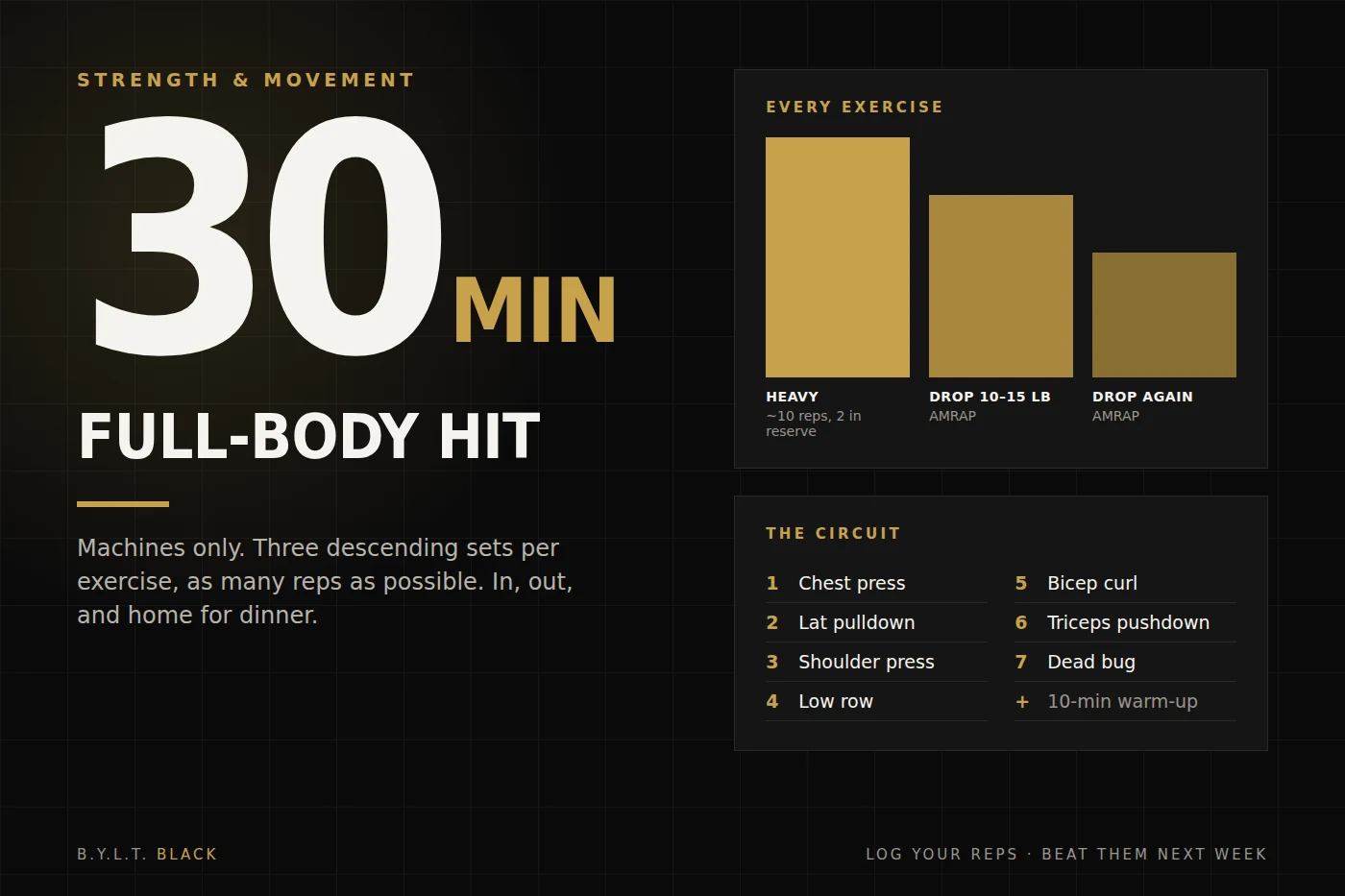
- Lift 2–3 times a week. Squats, push-ups, rows, carries. Muscle burns more energy and protects your joints and balance.
- Add some intervals. Brisk walking hills, bike sprints, or a few minutes of harder effort.
- Sleep 7–8 hours and manage stress. Poor sleep and chronic stress push hunger and fat storage the wrong way.
Measure what matters
Forget the mirror. Track these instead:
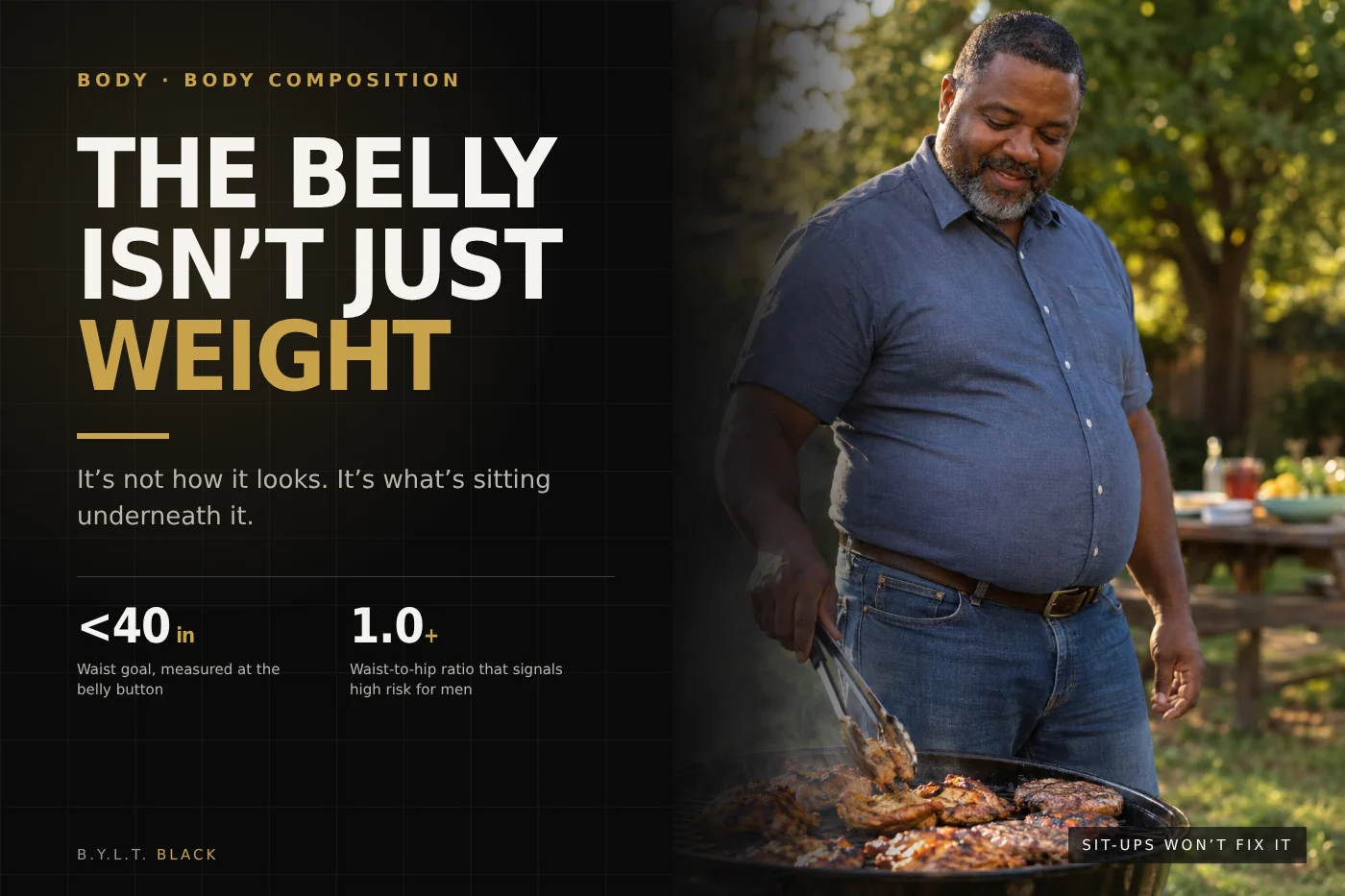
- Waist circumference. Measure at your belly button, standing relaxed. Goal: under 40 inches, and lower is better (Harvard Health Publishing).
- Waist-to-hip ratio. Waist ÷ hips. For men, 1.0 or higher signals high risk (Harvard Health Publishing).
- Your numbers. Blood pressure, A1C or fasting glucose, cholesterol, and triglycerides. In one trial, people who lost 5% or more of their visceral fat were more likely to improve waist size, HDL cholesterol, triglycerides, and A1C (National Institutes of Health, PMC).
The B.Y.L.T. bottom line
- That big belly isn’t “good living.” It’s often visceral fat, and it feeds high blood pressure, diabetes, and heart disease, the very conditions taking too many of our brothers.
- Sit-ups won’t fix it. What goes in your mouth will.
- Eat in a modest calorie deficit, lead with protein and vegetables, cut the liquid calories, and keep the foods you love in smart portions.
- Walk, lift, sleep, and measure your waist once a month.
- Know your numbers and get your annual checkup.
This isn’t about looking like a 25-year-old. It’s about being the 70-year-old who’s still walking the back nine, still showing up, still here.
Build it. Live it. B.Y.L.T.
Sources
- AARP. 4 health problems Black men should be concerned about.
- CDC, National Center for Health Statistics. FastStats: Health of Black or African American non-Hispanic population.
- Harvard Health Publishing. Overweight vs overfat: Is your scale lying to you?
- Harvard T.H. Chan School of Public Health. Body fat. The Nutrition Source.
- Healthline. Do ab exercises help you burn belly fat?
- Liu et al. (2022). Calorie restriction with or without time-restricted eating in weight loss. New England Journal of Medicine.
- Recchia et al. (2023). Dose–response effects of exercise and caloric restriction on visceral adiposity. British Journal of Sports Medicine.
- Redman et al. (2007). Effect of calorie restriction with or without exercise on body composition and fat distribution.
- The Conversation (2023). Can I actually target areas to lose fat, like my belly?
- HHS Office of Minority Health. Diabetes and Black/African Americans.
- HHS Office of Minority Health. Heart disease topic guide.
- Fasting triglyceride levels and waist circumference: Sex differences in visceral fat. NIH, PMC.
- Visceral adiposity loss is associated with improvement in cardiometabolic markers. NIH, PMC.
This article is for educational purposes and is not medical advice. Talk with your doctor before making major changes to your diet or exercise, especially if you have a health condition or take medication.