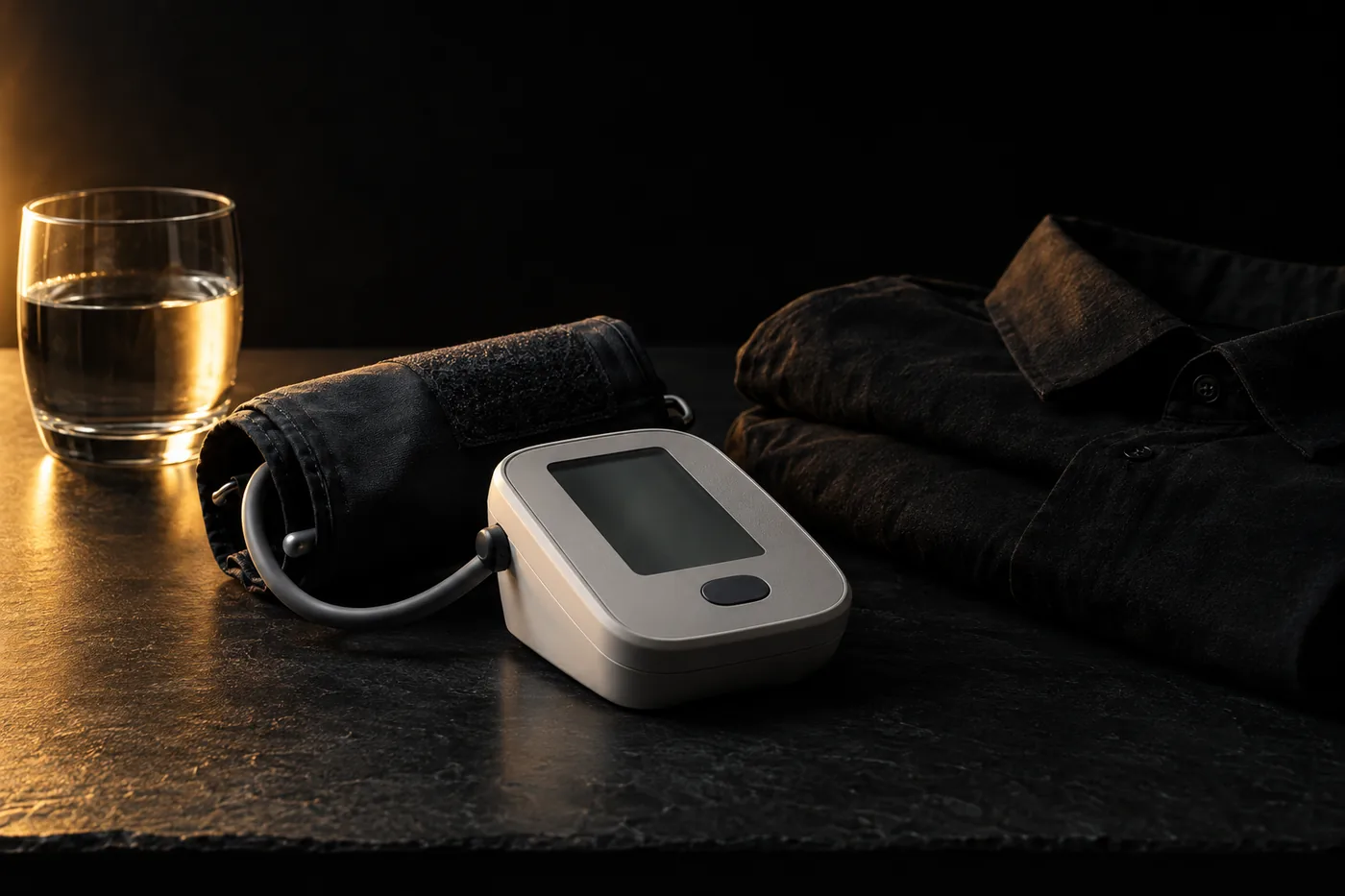
Almost every man I talk to who has high blood pressure can tell me his diagnosis. Far fewer can tell me his last two readings, and fewer still can tell me what number he and his doctor agreed to aim for. That gap is where the damage happens, because blood pressure is the one serious condition you can actually watch yourself, at home, for the price of a cuff.
It matters more for us than the general advice suggests. During August 2021 to August 2023, the age-adjusted share of US adults with hypertension was 44.5% overall — but among non-Hispanic Black adults it was 58.0%, the highest of any group the CDC measured. Risk of a first stroke is nearly twice as high for Black adults as for white adults, and the federal Office of Minority Health reports that Black men are about 70% more likely to die from a stroke than white men.
Blood pressure is the only major risk factor you can check yourself, at home, before it ever becomes a crisis.
What the two numbers are
A reading is written as systolic over diastolic. Systolic — the top number — is the pressure in your arteries while the heart is pushing. Diastolic, the bottom number, is the pressure that remains between beats. Both matter, and after roughly age 50 the systolic number tends to carry more weight in predicting cardiovascular risk, which is why a reading like 152/78 is not "fine because the bottom number is good."
| Category | Systolic | Diastolic |
|---|---|---|
| Normal | Under 120 | and under 80 |
| Elevated | 120–129 | and under 80 |
| Stage 1 hypertension | 130–139 | or 80–89 |
| Stage 2 hypertension | 140 or higher | or 90 or higher |
| Crisis — seek care now | Above 180 | and/or above 120 |
The 2025 high blood pressure guideline from the American Heart Association and American College of Cardiology sets a universal treatment target of under 130/80 mmHg, with individualised exceptions. That replaced the 2017 guideline, and it is worth knowing because some of the advice still circulating — "under 140 is fine at your age" — reflects guidance that has moved.
Measuring it properly, which almost nobody does
A bad measurement is worse than no measurement, because decisions get made on it. The technique is not complicated, but every step you skip inflates the number.
- No caffeine, nicotine, exercise, or a full bladder for 30 minutes beforehand.
- Sit for five quiet minutes first. Not scrolling, not talking. Just sitting.
- Back supported, feet flat on the floor, legs uncrossed.
- Bare upper arm resting on a table so the cuff sits at heart level. Sleeve rolled tight over the cuff throws the reading off.
- Cuff on correctly sized for your arm — a too-small cuff on a large arm reads high, which is a common and consequential error.
- Take two readings a minute apart and write both down. Do it morning and evening for seven days and bring the log with you.
What to bring to the appointment
A seven-day log of morning and evening readings is far more useful to a clinician than one number taken in a busy office after you rushed in from the parking lot. Write the date, time, both readings, and anything unusual — poor sleep, a missed dose, a stressful day.
White-coat and masked hypertension
Some men read high in the office and normal everywhere else — white-coat hypertension. Others read normal in the office and high at home, which is called masked hypertension and is the more dangerous of the two, because the office visit reassures everybody and the arteries keep taking the load. Home logs are the only way to tell these apart. If your home numbers and your office numbers disagree consistently, that is a finding worth raising out loud, not a measurement error to dismiss.
If you are already on medication
Three questions worth asking at your next visit, in this order:
- What number are we aiming for, specifically? Get a figure, and get it written in the notes.
- If I am not at that number in three months, what is the next step? Knowing the plan in advance stops a year of drift.
- Is there a reason for this particular drug for me? There is real evidence on which drug classes tend to lower pressure more effectively in Black patients, and it is a reasonable question, not a challenge to anybody's authority.
Do not stop or halve a medication on your own because your numbers came down. The numbers came down because of the medication. If side effects are the problem — and they often are, particularly the ones men do not want to bring up — say so plainly, because there are usually alternatives within the same goal.
Do not wait on these
Call 911 immediately for chest pain or pressure, sudden weakness or numbness on one side, a drooping face, trouble speaking or understanding speech, sudden vision loss, or a sudden severe headache unlike any you have had. With stroke, the treatment window is measured in hours and starts when the symptoms start.
The honest summary
The prevalence numbers are not destiny, and they are not a reason for fatalism. They are a reason to know your own figures, to take them properly, to write them down, and to walk into your next appointment with a page of data instead of a vague sense that things are probably okay. That single habit is the highest-leverage thing most men our age can do this month.
Sources
- CDC, QuickStats: Age-Adjusted Percentage of Adults With Hypertension, MMWR, August 2021–August 2023 data.
- CDC, Stroke Facts.
- HHS Office of Minority Health, Stroke and African Americans.
- 2025 AHA/ACC multisociety guideline for high blood pressure in adults, summarised by Cardi-OH; full text at Hypertension.
Category thresholds above reflect the AHA/ACC staging used in current US guidance. Guidelines are revised periodically; this article was last checked against the 2025 AHA/ACC guideline. Your own target may differ from the general figure, which is a conversation for you and your clinician.