The number on the scale
My food log shows that on January 15, 2012, I weighed 170 pounds. Seeing that number in writing stung. I had spent 30 years in uniform, doing PT and passing fitness tests. I was a high school athlete before that. If anybody should have known how to stay in shape, it was me.
What I learned over the next decade is that I never lost my fitness because I lost my motivation. I lost it because I lost my structure. Getting it back took habits, not willpower. Here is what that looked like, and what I would tell any brother starting over today.
The structure I didn’t know I was leaning on
I was a good athlete growing up, and a very good baseball player. The military built on that. Fitness wasn’t optional. There was PT every day and a test on a regular schedule, whether I felt like it or not.
The early military programs weren’t designed for a lifetime of fitness. But they did one thing extremely well: they made showing up mandatory. Somebody else owned my schedule, and somebody else was checking the results.
Then I moved up in rank. With rank came the freedom to train on my own, and with freedom came inconsistency. By my last couple of years, the calendar filled with appointments, retirement paperwork and planning for the next chapter. Workouts became the thing I would get to later.
I retired in 2006 not in my best shape. By 2007 and 2008 I was barely working out at all, and the weight came on quietly. That’s the danger zone nobody warns you about. A big life transition can remove the structure that was doing the work for you, and you don’t notice until the scale tells you.
I never lost my fitness because I lost my motivation. I lost it because I lost my structure.
Six habits that got me back
1. Replace the structure before you lose it
Retirement, a new job, kids leaving home, a move: each one can take away the routine that kept you moving. Build your own version first. Put workouts on the calendar like appointments, because that is what they are.
2. A resolution is not a plan
In 2012 I resolved to get back in shape. For the next couple of years I bounced between workouts and never found my lane, even with gyms and sports right in front of me. Deciding is not the same as planning. Pick one thing, a set time, and a minimum version you can still do on a bad day.
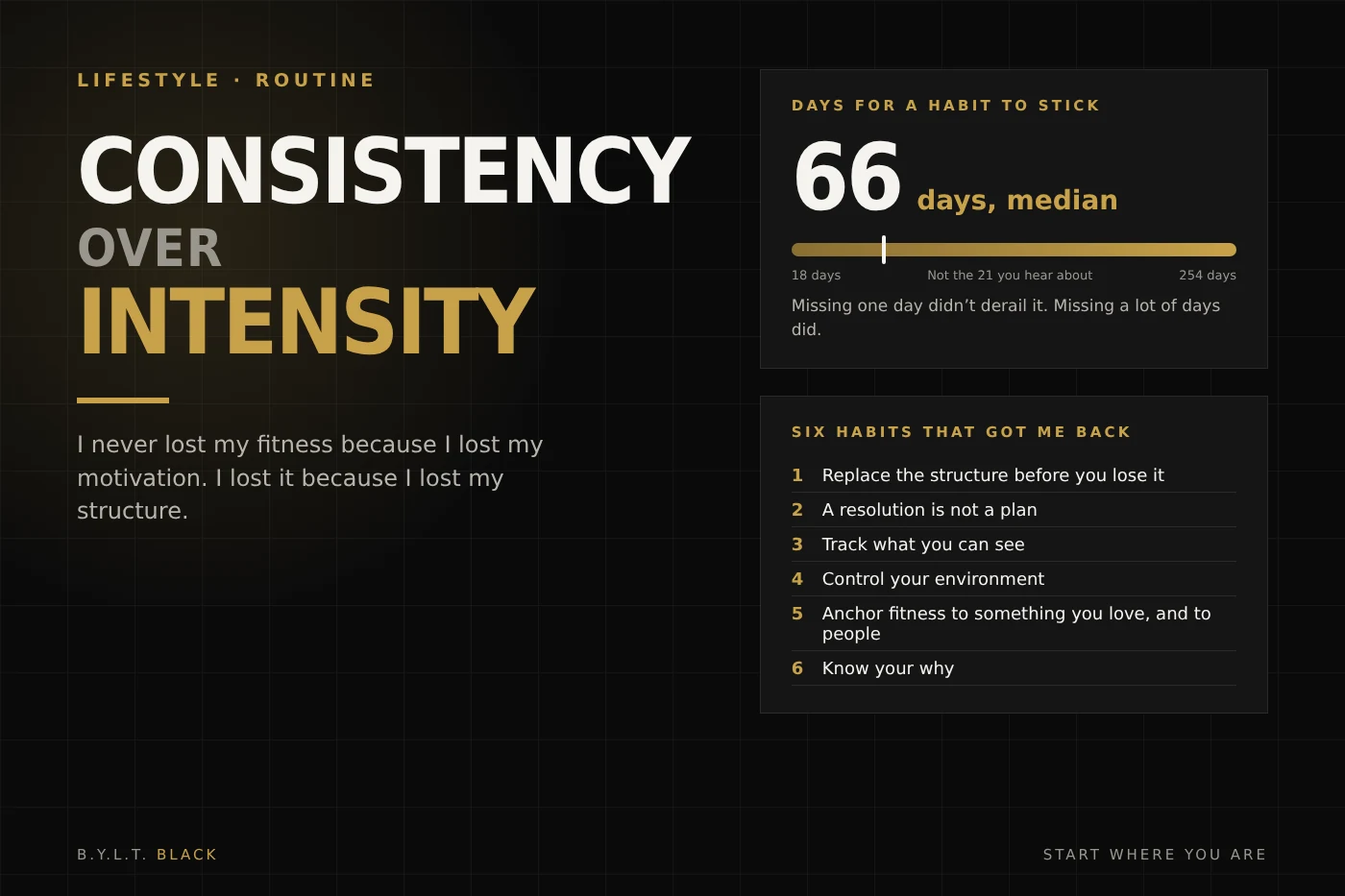
And be patient. In a well-known University College London study, a new daily behavior took a median of about 66 days to become automatic, not the 21 days you hear about. The range ran from 18 days to an estimated 254. The researchers also found that missing a single day did not derail the process. Missing a lot of days did.
3. Track what you can see
I started logging my food in a food-tracking database. At first I couldn’t connect the numbers to results, but I could finally see my calories and macros instead of guessing. That awareness came first. Research backs this up: a systematic review in the Journal of the American Dietetic Association found self-monitoring of diet, exercise and weight was consistently linked to weight loss, though the authors rated the evidence as weak and called for studies in more diverse groups.
4. Control your environment
Meal prep was my game changer. When the food is already cooked and portioned, the decision is made before hunger shows up. I stopped negotiating with myself at 7 p.m.
5. Anchor fitness to something you love, and to people
The most consistent thing I did through those years was golf. I fell in love with the game around 2000. Even playing only a couple of times a month, I kept coming back for the game and for the friendships it builds. Find your version of that, and find your people. The brotherhood matters as much as the workout. Our Tribe pillar makes that case.
6. Know your why
During this stretch I read a lot. Stephen Covey’s The 7 Habits of Highly Effective People and Simon Sinek’s Start with Why changed how I thought about change. The big lesson: consistency beats intensity. The second lesson took longer. Personal change is never just personal. It touches your family, your friends and the people you work with and lead. That’s a powerful reason to keep going.
When it finally clicked
Consistency clicked for me around 2019, just before COVID. I started treating food, sleep and exercise as a holy trinity. I still can’t tell you which of the three matters most. What I can tell you is that when all three were steady, I saw results.
The results weren’t about how I looked. They were about how I felt. My mind was clearer. Most days I woke up feeling great. I performed better at work and on the golf course because I could focus.
The other change was strength training. I set up a home gym with a strength-training machine that tracked every rep and added weight as I got stronger. That’s called progressive overload. Seeing it measured made resistance training the center of my routine instead of an afterthought.
That matters as we age. A 2022 meta-analysis in the British Journal of Sports Medicine found muscle-strengthening activity was linked to a 10% to 17% lower risk of early death, heart disease, cancer and diabetes. The biggest benefit showed up at roughly 30 to 60 minutes a week. These were observational studies, so they show a link, not proof of cause. If you’re new to lifting, start with Lifting after 50.
Where I am now
Today I still track, but it takes almost no effort. Wearables have become much less intrusive. They collect the data in the background without me thinking about it. I use a fitness tracker for sleep and recovery, a food-tracking database for meals and my strength-training machine for workouts.
I’ve also gone deeper on blood work. I get a biomarker panel that tests things a routine physical often skips, like lipoprotein(a), or Lp(a). According to the American Heart Association, Lp(a) is largely inherited, it isn’t part of a standard cholesterol test, and Black people of African descent often have the highest levels. Diet and exercise don’t lower it, which is exactly why it’s worth knowing. Ask your doctor whether you should be tested.
I won’t pretend my health story is perfect. I’ve had challenges that are arguably hereditary, not the result of what I eat or drink. I’m also living with prostate cancer, which is why I watch my PSA closely and tell every brother to get his baseline test early. But I weigh 150 pounds today and have held that weight for about ten years, and my fitness lets me function at a high level every day. If I want to play five rounds of golf in a week, I can, with very little soreness or fatigue.
I’ve even started comparing my fitness tracker’s recovery score with how I play. My own experience says low-recovery days tend to be my rough rounds. That’s one man’s pattern, not science, but it keeps me honest about sleep.
Your first step
You don’t need my gadgets to start. You need a starting line and a routine you can keep. Here’s what I’d do this week:
This week
- Take the at-home fitness assessment. It needs one chair and about twenty minutes.
- Put two short strength sessions on your calendar, same days and times every week.
- Track one thing for 30 days: food, sleep or workouts. Just one.
- Tell one friend what you’re doing and ask him to check on you.
It took me ten years to learn that consistency beats intensity. You can learn it in ten weeks. Start where you are, show up on the days you don’t feel like it, and let the habits do the heavy lifting.
Sign-off: my numbers
I’m closing the way I hope every writer here will: with my numbers. These are six numbers every man should know, especially Black men. Get them in writing, and check them every six months to a year. Ranges below are general guideline targets. Your doctor sets yours.
| Number | Healthy range | How often | Mine (2026) |
|---|---|---|---|
| Blood pressure | Under 130/80 (AHA/ACC 2025) | Every checkup, plus at home | 119/80 (average) |
| LDL cholesterol + Lp(a) | LDL under 100 for many men; Lp(a) under 125 nmol/L (ACC/AHA 2026) | LDL with yearly labs; Lp(a) once in your life | LDL 63 mg/dL; Lp(a) 137 nmol/L |
| A1c (blood sugar) | Under 5.7% (ADA 2026) | At least every 3 years from age 35; yearly if 5.7% or higher | 4.9% |
| PSA | No single cutoff; your doctor watches the trend (PCF) | Baseline at 40–45 for Black men; yearly strongly considered | 4.3 ng/mL |
| Weight + waist | Waist under 40 inches; weight steady | Monthly at home | 150 lb / 29 in |
| Kidney (eGFR + urine albumin) | eGFR 60 or higher; urine albumin 30 mg/g or less (NKF) | Yearly, especially with high blood pressure or diabetes | eGFR 76; urine albumin normal |
What are yours? If you don’t know, that’s your first step. Take this list to your next appointment.
Sources
- Lally P, et al. (2010). How are habits formed: Modelling habit formation in the real world. European Journal of Social Psychology. Summary via UCL News.
- Burke LE, Wang J, Sevick MA (2011). Self-monitoring in weight loss: a systematic review of the literature. Journal of the American Dietetic Association.
- Momma H, et al. (2022). Muscle-strengthening activities are associated with lower risk and mortality in major non-communicable diseases. British Journal of Sports Medicine.
- American Heart Association. Lipoprotein(a).
This article shares one man’s experience and is not medical advice. Talk with your doctor before starting a new exercise program.