Before you begin
This simple self-check is designed to give men over 50 a practical baseline for strength, balance, mobility, and cardiovascular fitness. It is not a medical exam or diagnosis.
- Wear supportive shoes and use a stable, non-slip surface.
- Keep a sturdy chair and a wall or counter nearby for balance.
- Stop immediately for chest pain, unusual shortness of breath, dizziness, faintness, or joint pain.
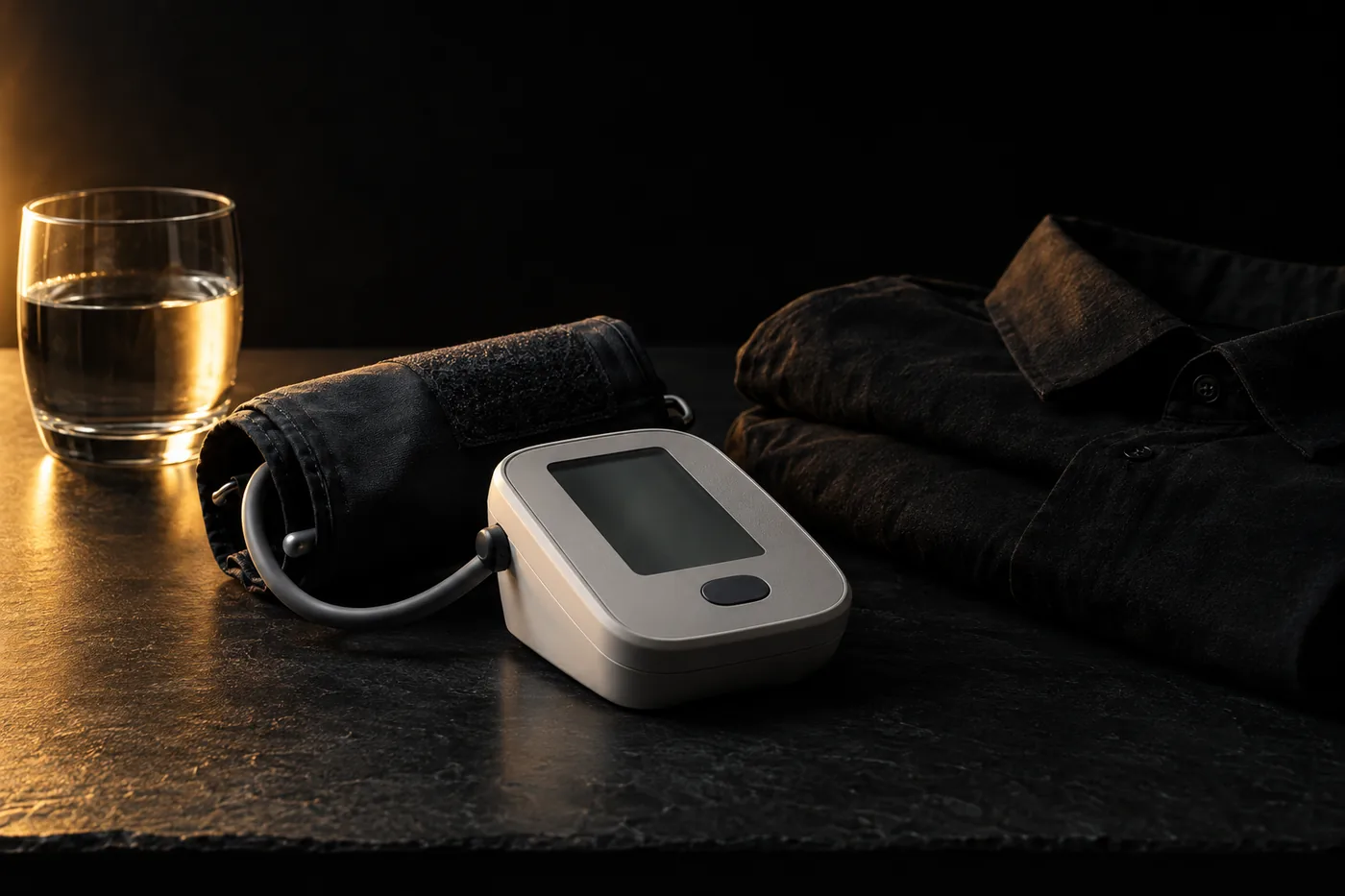
- If you have a heart condition, uncontrolled blood pressure, recent surgery or injury, or have been inactive for a long time, ask a qualified clinician before testing.
What you need: a sturdy armless chair, a stopwatch or phone timer, a wall, a measuring tape, and a clear walking area.
Record today’s date and repeat this assessment every 8–12 weeks under similar conditions.
Your scorecard
Print this page or copy the table into a notebook. One sheet per test date.
| Test | Your result | Baseline goal | What it measures |
|---|---|---|---|
| 30-second chair stand | ____ reps | 10–17 reps | Lower-body strength |
| Six-minute walk | ____ distance | Track improvement | Cardiovascular endurance |
| Single-leg balance | R ____ sec / L ____ sec | 10+ sec per side | Balance and fall-risk awareness |
| Wall push-up | ____ reps | 10–20 controlled reps | Upper-body pushing strength |
| Chair sit-and-reach | ____ in/cm from toes | Improve toward toes | Hamstring and low-back mobility |
| Shoulder reach | R ____ / L ____ | Hands closer together | Shoulder mobility |
Your overall priority:
1. 30-second chair stand
Why it matters: Strong legs support walking, climbing stairs, golf, getting off the floor, and independent living.
How to do it
- Place a sturdy chair against a wall.
- Sit tall near the front edge, feet flat and about hip-width apart.
- Cross your arms over your chest if comfortable. If needed for safety, keep your hands lightly available near the chair.
- Start the timer and stand all the way up, then sit all the way down.
- Complete as many full, controlled stands as possible in 30 seconds.
Record: ____ full stands
Simple reference
| Result | General interpretation |
|---|---|
| 17+ | Strong functional lower-body capacity |
| 10–16 | Solid baseline; keep building strength and consistency |
| Under 10 | Make leg strength and daily movement a priority; consider professional guidance if rising from a chair is difficult |
Bands adapted from the CDC’s 30-Second Chair Stand assessment, which lists below-average scores for men as fewer than 14 stands at 60–64, fewer than 12 at 65–74, and fewer than 11 at 75–79, and from the Rikli and Jones criterion standards for maintaining physical independence — 17 stands at 60–64 down to 14 at 75–79 — as summarised by Shirley Ryan AbilityLab.
Use this as a personal baseline rather than a competition. Good form matters more than rushing.
If standing repeatedly for 30 seconds is too much, the five-times sit-to-stand test is a gentler alternative: time five stands. Healthy reference means are 7.7 seconds at 50–59, 7.8 at 60–69, and 9.3 at 70–79.
2. Six-minute walk
Why it matters: Walking capacity reflects everyday cardiovascular endurance and can reveal whether your current activity level is improving.
How to do it
- Choose a flat, safe route — a driveway, sidewalk loop, hallway, or local track.
- Warm up with 2–3 minutes of easy walking.
- Walk at a purposeful pace for six minutes. You should be working, but still able to speak in short sentences.
- Record your distance. On an indoor route, count laps and multiply by the route length.
Record: ____ steps / ____ laps / ____ feet or meters
What to look for
- The most valuable measure is change over time.
- Retest on a similar route, at a similar time of day, every 8–12 weeks.
- A longer distance at the same perceived effort is progress.
- If you must stop because of chest discomfort, severe breathlessness, dizziness, or pain, stop and seek medical advice.
For context rather than a target: in the reference study behind the clinical six-minute walk test, the median distance for healthy men aged 40–80 was 576 metres, and a seven-country reference study found a mean of 571 metres, with distance falling steadily by decade. Those figures come from a measured indoor course; your driveway loop is not the same test, which is why change over time is the number that matters here.
3. Single-leg balance
Why it matters: Balance supports confident walking, stair use, golf, and fall prevention.
How to do it
- Stand beside a counter or wall so you can steady yourself immediately if necessary.
- Hold the counter lightly at first, then release your hand if safe.
- Lift one foot a few inches off the floor and balance on the other leg.
- Time up to 30 seconds. Stop if the raised foot touches down, you grab support, or you feel unsafe.
- Repeat on the other side.
Record: Right ____ seconds | Left ____ seconds
Simple reference
| Result per side | General interpretation |
|---|---|
| 20–30 seconds | Strong practical balance |
| 10–19 seconds | Good starting point; continue balance work |
| Under 10 seconds | Prioritize supported balance practice, and discuss repeated unsteadiness or falls with a clinician |
Published means for men standing on one leg with eyes open are 41.5 seconds at 50–59, 33.8 at 60–69, and 25.9 at 70–79. A meta-analysis of adults aged 60 to 99 put the average at 15.7 seconds. The 30-second ceiling above is a safety choice for testing alone at home, not a fitness limit — and under 10 seconds sits below the average for every age group in that research.
A meaningful side-to-side difference is worth noting. Train the weaker side gently and consistently.
4. Wall push-up
Why it matters: This checks the upper-body pushing strength needed for daily tasks — pushing doors, getting up from the ground, handling equipment.
How to do it
- Stand facing a wall, about arm’s length away.
- Put your hands on the wall at shoulder height and slightly wider than shoulder width.
- Keep your body in a straight line from head to heel.
- Bend your elbows and lower your chest toward the wall.
- Push back to the starting position with control.
- Complete as many good-form repetitions as you can, stopping when your form breaks down.
Record: ____ controlled repetitions
Simple reference
| Result | General interpretation |
|---|---|
| 20+ | Strong wall-push-up capacity |
| 10–19 | Useful functional baseline |
| Under 10 | Begin with wall push-ups 2–3 days per week and build gradually |
We could not find published age-and-sex reference values for the wall push-up specifically. The bands above are practical starting points, not norms — treat this test purely as your own before-and-after number.
Keep your shoulders away from your ears and avoid holding your breath.
5. Chair sit-and-reach
Why it matters: Hamstring and low-back mobility affect walking comfort, bending, posture, and your ability to move athletically.
How to do it
- Sit near the front of a sturdy chair.
- Keep one foot flat on the floor. Extend the other leg with the heel on the floor and toes pointing upward.
- Sit tall, then slowly reach both hands toward the toes of the extended leg.
- Do not bounce or force the stretch. Hold the furthest comfortable position for two seconds.
- Measure the distance from your fingertips to your toes.
Record:
- Fingertips short of toes: ____ inches/cm
- Fingertips at toes: 0
- Fingertips past toes: ____ inches/cm
Repeat on the other side if one side feels noticeably tighter.
Goal: Gradually reduce the distance to your toes, or improve comfort and symmetry. Mobility should improve without sharp pain, numbness, or tingling.
The chair sit-and-reach and the shoulder reach are both drawn from the Senior Fitness Test battery of Rikli and Jones, built on 7,183 community-dwelling US adults aged 60 to 94. Age-banded normal ranges are reprinted from the Senior Fitness Test Manual.
6. Shoulder reach
Why it matters: Shoulder mobility affects reaching overhead, dressing, posture, exercise technique, and the ability to make a comfortable golf swing.
How to do it
- Reach one hand over your shoulder and down your back.
- Reach the other hand behind your back and upward.
- Try to bring the middle fingers toward each other without forcing the motion.
- Repeat with the arm positions reversed.
Record:
- Right arm overhead: fingers ____ inches/cm apart / touching / overlapping
- Left arm overhead: fingers ____ inches/cm apart / touching / overlapping
Goal: Improve comfort and reduce major differences between sides. Do not push through shoulder pain.
Make sense of your results
Use your assessment to choose one or two clear priorities — not to judge yourself.
| If this test felt hardest | Focus for the next 8 weeks |
|---|---|
| Chair stands | Sit-to-stands, step-ups, bodyweight squats, and regular walking |
| Six-minute walk | Add 10–20 minutes of brisk walking most days and gradually include short faster intervals |
| Single-leg balance | Practice supported single-leg stands, heel-to-toe walking, and lower-body strength work |
| Wall push-ups | Wall push-ups 2–3 times per week; progress slowly by moving your feet farther from the wall |
| Sit-and-reach or shoulder reach | Add gentle daily hamstring, hip, chest, and shoulder mobility work |
Retest and build
Repeat the same assessment every 8–12 weeks. Record your numbers, how you felt, and any pain or limitations. The best outcome is not perfection — it is being able to walk farther, stand stronger, move with more confidence, and stay capable for the people and purpose that matter to you.
Important: A lower score is a starting point, not a label. Begin at a level you can do safely, progress gradually, and seek individualized guidance if pain, falls, severe fatigue, or concerning symptoms are part of your routine.
Where these numbers come from
Three of these six tests come from validated batteries with published reference values: the chair stand, the six-minute walk, and single-leg balance. The sit-and-reach and shoulder reach are taken from the Senior Fitness Test protocol, though the version here is scored by feel and distance rather than against percentile tables. The wall push-up has no published norms we could find, and its bands are practical judgement.
Two honest caveats. First, most of this research starts at age 60, so men in their fifties will find fewer reference points than they might expect. Second, published norms are gathered in clinics with a 17-inch chair, a measured course, and someone else holding the stopwatch. Running the same tests alone at home gives you a useful personal baseline, not a clinical score.
Sources
- Centers for Disease Control and Prevention, STEADI, Assessment: 30-Second Chair Stand (PDF) — protocol and below-average scores by age and sex.
- Shirley Ryan AbilityLab, 30-Second Sit to Stand Test — Rikli and Jones criterion standards for maintaining physical independence, n = 2,140.
- Academy of Neurologic Physical Therapy, Five Times Sit to Stand pocket guide (PDF) — protocol and healthy normative values by decade.
- Springer BA et al., Normative Values for the Unipedal Stance Test with Eyes Open and Closed, Journal of Geriatric Physical Therapy (PDF).
- Bohannon RW, Single Limb Stance Times: a descriptive meta-analysis (PDF) — 3,484 participants aged 60 to 99.
- Enright PL and Sherrill DL, Reference equations for the six-minute walk in healthy adults, American Journal of Respiratory and Critical Care Medicine, 1998.
- Casanova C et al., The 6-min walk distance in healthy subjects: reference standards from seven countries, European Respiratory Journal, 2011.
- Shirley Ryan AbilityLab, 6 Minute Walk Test — protocol and gender-specific reference equations.
- Shirley Ryan AbilityLab, 2 Minute Step Test — an indoor alternative to the walk test, with Rikli and Jones step-count standards for men by age.
- Rikli RE and Jones CJ, Senior Fitness Test Manual, 2nd edition — chair sit-and-reach and back-scratch normal ranges, reprinted by permission.
This assessment is a self-check you run at home. It is not a clinical fall-risk screen, and it does not replace an in-person evaluation. If you are worried about your balance, your heart, or a recent fall, bring these numbers to your clinician rather than acting on them alone.